

Certified Fraud Exam: Fraud Prevention and Deterrence Section Explained (CFE)
Certified Fraud Exam: Fraud Prevention and Deterrence Section Explained (CFE)
Fraud prevention is not simply about identifying fraudulent activity once it has occurred; it is also about recognizing where fraud may arise and how an organization can take steps to prevent it prior to occurrence. The Fraud Prevention & Deterrence area of the Certified Fraud Examiner exam focuses on this concept. This portion of the exam assesses a candidate’s ability to apply concepts such as risk assessment, internal controls, ethics, and governance to real-world job scenarios.
What the Fraud Prevention and Deterrence section tests
This section of the Certified Fraud Exam doesn’t talk about knowing what fraud is; rather, it talks about understanding how to stop it from happening in the workplace. It checks if you know the step-by-step procedure to prevent fraud. It also checks whether you understand how to control fraud, how to evaluate risks, how companies manage fraud, and what it means to act honestly.
The Certified Fraud Exam deals with Fraud Prevention and Deterrence and talks about how companies can spot fraud risks and do something about them before things get worse.
You might hear questions about building a workplace where it’s harder to commit fraud and easier to catch it. In simpler words, it could be said that this section checks if you can match fraud risks with the best ways to stop them in a real company.
Why Fraud Happens: Understand with Criminology and white-collar crime theories
Imagine a workplace situation. Did you ever think about how and why fraud really begins?
An accounts employee is facing money problems, which is pressure. The employee sees that expense claims are rarely checked, which is opportunity. The employee thinks they will pay the money back later, which is rationalisation. Because the employee knows the reimbursement steps and can see the records, which is capability, the employee can file fake claims, and no one notices right away.
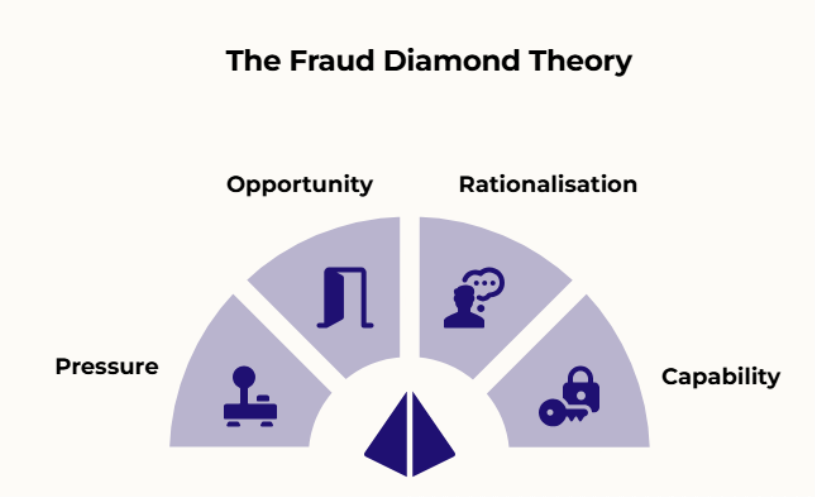
When we talk about the Fraud Triangle, have you ever wondered why someone who looks trustworthy at work would decide to commit fraud?
The Fraud Triangle helps to explain this by looking at three factors that can come together.
- Pressure: It could be some financial stress, personal problems, or even pressure to meet unrealistic targets.
- Opportunity: A gap in internal controls, limited supervision, or an unchecked process can give someone the chance to commit fraud.
- Rationalisation: The person may convince themselves that what they are doing is justified, such as thinking, “I’ll pay it back” or “I’m only taking what I deserve.”
Breaking Down the Fraud Diamond Theory in brief.
What if someone has the opportunity but still cannot commit fraud? That is where the Fraud Diamond comes in. It adds a factor:
- Capability: The person has the right access, knowledge, authority, or confidence to carry out and potentially conceal fraud.
Corporate governance and management’s responsibility for fraud prevention
When it comes to preventing fraud, writing down policies is not enough.
It matters who sets the standards, who looks for risks, and who makes sure the controls actually work. That is where corporate governance and management come into play. Governance provides oversight. Management takes on the task of putting fraud prevention measures into practice.
Corporate Governance
Fraud prevention starts, when a senior leader always shows behavior and takes bad decisions seriously, it gives a clear view of what is expected from everyone in the company.
The board and audit committee should not just trust what management says; they need to ask questions, check the controls, and look into areas where there might be a risk of fraud.
Employees are the first ones to detect that something is wrong. Confidential whistleblower channels provide a means for them to express concerns without fear of repercussions.
Management’s Responsibilities
Management always makes sure that the day-to-day processes have the right checks in place, such as authorizations, divisions of responsibilities, access restrictions and periodic assessments can help ensure that no person has much power over a control over a process.
Fraud risk may change as processes, staff, and technologies keep changing. Management needs to take care of places where fraud might happen, factors that might cause fraud risk, and whether current controls are still working.
Reliable financial and operational reporting is very important. Management is responsible for making sure that information is recorded correctly and that major problems are not ignored or misrepresented.
Setting up controls is just the first step; management must keep an eye on whether controls work well and deal with problems when they are noticed.
For CFE candidates, understanding these roles makes it easier to see how fraud prevention works beyond theory and within an actual organization.
Fraud risk assessment vs fraud risk management in the exam
Think of fraud assessment as looking at that possibility and understanding how serious it could be.
What if an employee has access to financial records, understands the payment process, and knows how the internal controls work? Even when an opportunity exists, that person’s knowledge and authority may make the fraud easier to carry out and hide.
Fraud risk and fraud assessment go hand in hand. Fraud risk and fraud assessment are not the same thing. Think of fraud risk as the moment you notice where something might go wrong. Think of fraud assessment as the time you step back and look closely at that possibility.
- Fraud Risk: Fraud might occur even in an organization; it can come from controls, little oversight, missing steps in a process, or when management skips normal procedures. In short, it answers the question: Where could fraud happen?
- Fraud Assessment: After a potential risk is found, the next step of fraud assessment is to look deeper into the risk. It examines how fraud might take place, how likely it is to happen, and what kind of damage it could cause to the business.
Spotting a risk is part of the task. Assessing it helps the organization decide which areas need attention. It points out where stronger safeguards or better monitoring should be put in place. Without assessment, knowing about a risk is not enough.
ACFE Code of Professional Ethics
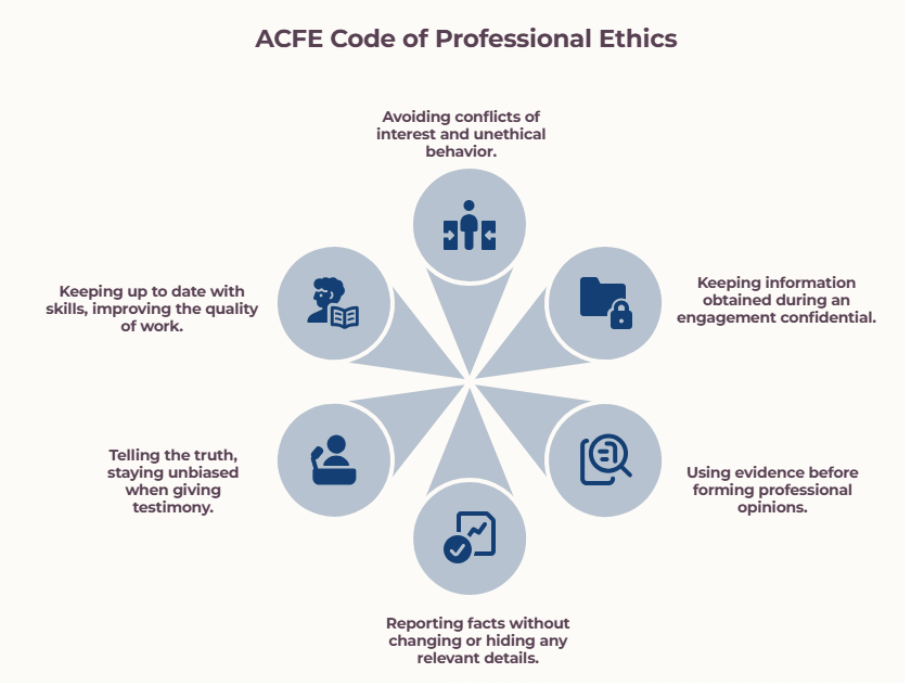
The ACFE Code of Professional Ethics focuses on professionalism, integrity, competence, and diligence. This Code in the Certified Fraud Exam sets up standards that fraud examiners must follow in their work. It is very important for CFE candidates because decision-making is a major part of fraud examinations. The Code focuses on being professional, honest, skilled, and careful.
It also includes real-world responsibilities such as:
- Avoiding conflicts of interest and unethical behavior.
- Keeping information obtained during an engagement confidential
- Using evidence before forming professional opinions.
- Reporting facts without changing or hiding any relevant details.
- Telling the truth, staying unbiased when giving testimony.
- Keeping up to date with skills, improving the quality of work.
For a fraud examiner, these rules help make sure that investigations are done properly, fairly, and with honesty.
High-yield concepts and common mistakes
Preparing for the CFE exam is not about going through the syllabus and memorizing information. It is also about how you think when you face questions and how you use what you have learned in situations. The exam includes multiple-choice questions and true/false questions that are spread across three sections.
So, it is very important to take your time with each question. You must understand exactly what the question is asking. Practice every day, even if it is a few questions. This helps you get used to the way questions are written. It builds your confidence when you apply what you know.
- Memorizing without understanding: Focusing on definitions and facts that can make it difficult to use concepts in real situations.
- Reading questions quickly: Missing words such as except, most likely, or best can completely change what the question is asking.
- Mixing up concepts: Treating concepts such as fraud prevention and fraud detection as the same can lead to choosing the wrong answer.
- Overthinking the question: Adding assumptions that aren’t in the question can take you away from the information that is given.
- Spending much time on one question: Getting stuck on a difficult question can leave less time for other questions.
- Using study material: Preparing from older exam content can mean missing changes to the current CFE exam structure and syllabus.
- Skipping practice questions: Studying theory without doing practice questions can make it harder to feel comfortable with the exam format and question style.
Why Netrika?
The CFE exam programme combines instructor-led learning, exam-focused study material, practice assessments, mock exams, trainer assistance, and administrative support.
It’s been over a decade, Netrika has been helping professionals build specialized skills through industry-focused training, including CFE preparation. As an ACFE-authorized training partner in India, Netrika has trained thousands of professionals through structured programmes supported by experienced trainers with 25+ years of fraud-risk management expertise.
The focus is simple: help candidates understand fraud concepts, apply them to workplace situations, and approach the CFE exam with greater confidence.
FAQ
- 1. What does the Fraud Prevention and Deterrence section of the CFE exam test?
- It tests candidates on the topic of fraud risk management. It looks at prevention strategies. It covers controls. It includes governance. It talks about ethics. It checks deterrence measures.
- 2. What are the key concepts covered in this CFE section?
- The main areas include fraud risk assessment, internal controls, corporate governance, ethical practices, fraud prevention programs, and deterrence strategies.
- 3. Why is fraud risk assessment important for CFE candidates?
- This helps candidates see how organizations spot fraud schemes. We learn why fraud schemes are dangerous, how to assess risks, and how to decide which areas need controls.
- 4. What role do internal controls play in fraud prevention?
- Internal controls help reduce fraud opportunities; internal controls ensure proper approvals, separate duties, monitor activities, provide oversight, and hold people accountable.
- 5. How can candidates prepare for the Fraud Prevention and Deterrence section?
- Candidates should understand core concepts, practice scenario-based questions, review theories, and focus on applying concepts practically because concepts are the backbone of success.
What does effective CFE preparation look like?
Build a stronger foundation in fraud prevention, investigation, ethics, and risk with focused CFE training from Netrika.
Visit: www.netrika.com | Call: 1800 121 300000 | Email: trust@netrika.com
