

Forensic Analysis Techniques vs Internal Audit vs Statutory Audit: Key Differences Explained
Forensic Analysis Techniques vs Internal Audit vs Statutory Audit: Key Differences Explained
Who checks if something went wrong, and why does that happen? Is it a compliance auditor, or a forensic examiner? Getting a deeper understanding of the audit is moving forward.
Even though all three of them might look at statements, the way they work is different. I think that a forensic examiner and forensic examination focus on finding proof of fraud or bad behavior. I also feel that internal audits and statutory audits mainly look at controls, follow rules, and make sure financial information is correct.
Understanding Forensic Analysis Techniques, Internal Audit and Statutory Audit
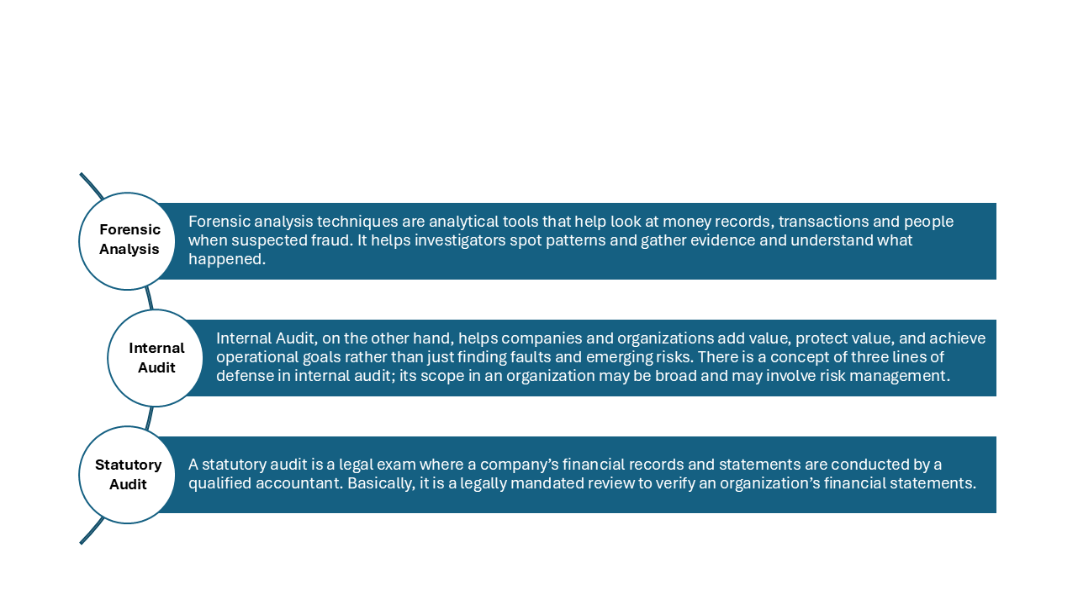
Forensic analysis techniques are analytical tools that help look at money records, transactions and people when suspected fraud. It helps investigators spot patterns and gather evidence and understand what happened. Common techniques include data analytics, Benford’s Law, and interviews that start with neutral questions before moving towards possible admissions.
Internal Audit, on the other hand, helps companies and organizations add value, protect value, and achieve operational goals rather than just finding faults and emerging risks. There is a concept of three lines of defense in internal audit; its scope in an organization may be broad and may involve risk management.
A statutory audit is a legal exam where a company’s financial records and statements are conducted by a qualified accountant. Basically, it is a legally mandated review to verify an organization’s financial statements. It provides a true and fair view of the financial position. Its main purpose is to ensure legal compliance, preventing and detecting errors or frauds that build trust with investors, lenders, and regulators.
Different risks cater to different kinds of audits; the right audit can make a difference.
Explaining the Objective, scope, timing, and triggers of audit types
| Audit Type | Objective | Scope | Timing | Triggers |
|---|---|---|---|---|
| Forensic Analysis Techniques | The primary goal of forensic analysis techniques is to rebuild past events based on empirical evidence. It points out how a breach or fraud is actually occurring. | The scope defines a strict scope that keeps the investigation efficient, legally compliant, and cost-effective. | Timing is everything; as soon as a threat is detected, live memory accusation and network traffic capture must happen immediately. | Flagging suspicious employee behavior, potential intellectual property theft, or insider fraud are the main pain points. |
| Internal Audit | The main objective is to manage risk, compliance, and process optimization. Identifying flaws and ensuring compliance with regulations and data privacy. | The scope of internal audit involves financial controls, operational processes, IT and cybersecurity, and regulatory compliance. | The internal audit should not panic. It creates a risk-based schedule at the start of the year. It might be audited every 6-12 months. | The main pain points in the internal audit involve the red flags in the financial statements and anonymous employee tips regarding misconduct. |
| Statutory Audit | The main aim is to enhance credibility, verify compliance, and identify errors. It reassures shareholders, investors, and financial institutions. It ensures the company follows accounting standards, tax laws, and industry regulations. | The scope covers the financial statements, internal controls, supporting evidence, and regulatory disclosures. | Statutory audits operate on a strict schedule. It involves the annual frequency, which is once a year at the end, post-closing timing, and lastly, filing deadlines. | Unlike voluntary audits, statutory audits are automatically triggered by specific legal thresholds. |
How are Evidence standards and legal admissibility collected and used in Different Types of Audits?
Evidence standards and legal admissibility matter in audits because the findings are credible, defensible, and professionally difficult to challenge in regulatory investigations.
Knowing these audits is really about proving where the evidence can be put to work.
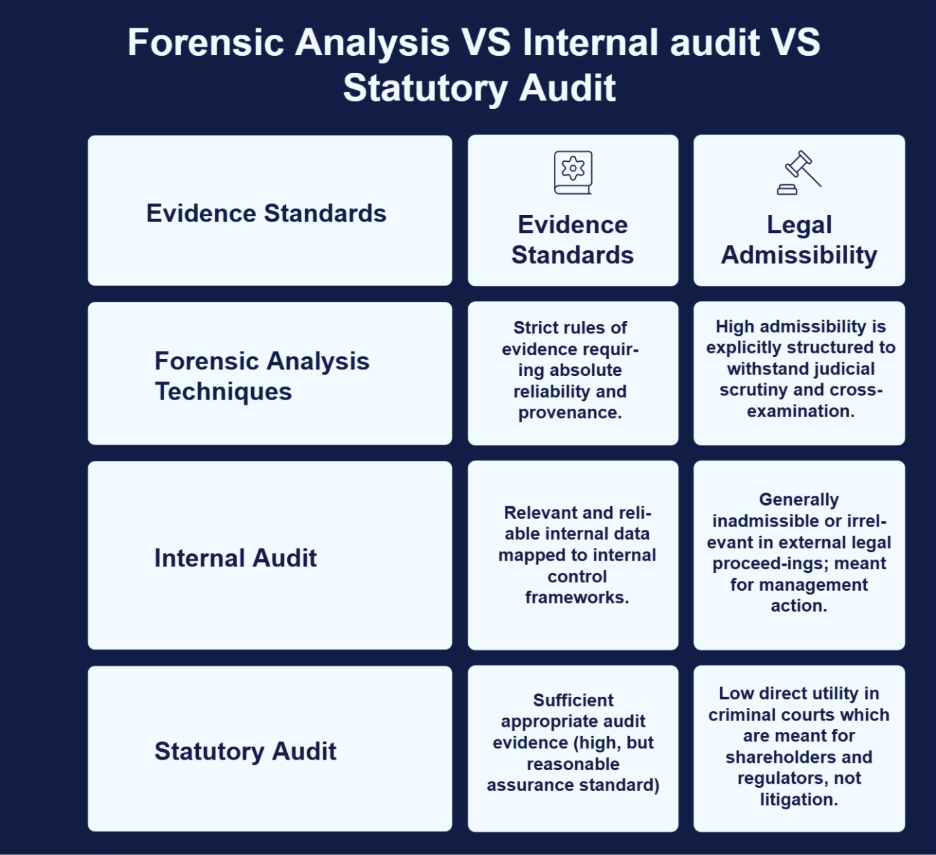
Still questioning which audit type to choose to identify malicious activities? Don’t, because organizations now have a deeper knowledge of which one to choose.
Which Audit Type Fits the CIA and CFE Exams?
This is all very confusing at first. All three of these audits check what is happening inside the organization. But their purpose is quite different.
In simple terms, it asks, ‘ Is the organization working the way it should, and where can it do better? Internal audit aligns perfectly with the Certified Internal Auditor exam; it is a certification for internal auditing, focusing extensively on internal controls, risk management, governance, etc. The forensic analysis techniques are parallel to the Certified Fraud Examiner exam. The Certified Fraud Examiner exam focuses completely on fraud prevention, detection, and investigation. The forensic analysis identifies anomalies/irregularities regarding financial records and involves interviewing witnesses, which is a core competency of the certified fraud examiner curriculum.
Here is a question for you to answer: ‘Something looks wrong; what happened, how did it happen, and what evidence can prove it?’
The statutory audit does not fit in either of the exams. However, the statutory requirements and financial statement fraud are tested on the Certified Fraud Examiner exam, and coordinating with the external auditors is touched upon in the CIA Exam.
When an organization needs a forensic audit
The organization doesn’t always need a forensic analysis technique when it initiates a systematic investigation to preserve, collect, and analyze digital or physical data following a security breach, fraud suspicion, or legal compliance requirements.
An organization takes immediate actions when a situation like this occurs, such as incident isolation, evidence preservation, chain of custody maintenance, and engaging specialists who can solve an issue like this and resolve it at the right moments when needed. Most organizations bring in a cybersecurity expert in cases like these. They examine the situation without destroying the key evidence.
Steps for core forensic analysis:
During a data examination and reconstruction, it focuses on solving the problem by using some specific tools such as Wireshark, which is only specialized for networks and Volatility, for memory to recover deleted files check logs and build the timeline of events.
In root cause analysis, as the word suggests, the investigators find out how an attacker got in, how much the threat spread, and which specific data or systems were affected.
Why choose Netrika?
Netrika helps organizations move from simply identifying gaps to resolving the issues case by risks. The bigger question here is how important the risk is and what could be done to simplify and resolve the issue.
We bring our expertise by offering services like fraud investigation, internal audit support, risk management, and security assessments. We have knowledge in areas such as fraud investigations, forensic accounting, asset tracing, transaction testing, evidence gathering, and background verification.
With a collective experience of 100+ years with its multi-disciplinary team can approach an assignment from both an audit and investigative perspective. With team of 350+ professionals, Netrika brings together forensic experts, CAs and MBAs, cybersecurity professionals, and risk consultants. Netrika has worked with 1,500+ clients, giving the team exposure to different business models, industries, and risk environments.
Risk rarely fits into one discipline. They require the right expertise to resolve the issue.
FAQs
- 1. What is the primary objective of each audit?
- A statutory audit makes sure the financial statements are correct and follow the rules. Internal Audit checks for risks. It also checks how well the company’s controls are working. Forensic Audit looks into fraud and collects proof to back it up.
- 2. What triggers each type of audit?
- A statutory audit happens because of laws and regulations. Internal Audit is done regularly to keep track of risks and help with decision-making. Forensic Audit starts when there are warning signs, like financial activity or conflicts.
- 3. Who receives the audit report?
- Statutory Audit reports go to shareholders and government regulators. Internal Audit reports are shared with company managers and the board of directors. Forensic Audit reports are given to management, legal teams, or people leading the investigation.
- 4. How deep is the testing in each audit?
- Statutory Audit usually tests a sample of transactions based on risk. Internal Audit digs into how processes and controls work. Forensic Audit goes into specific transactions, analyzes data, and gathers evidence step by step.
- 5. When should a company consider an audit?
- A forensic audit is worth doing when there are warning signs, like suspected fraud, money going missing for no reason or a financial dispute with someone inside or, outside the company.
Is your organization ready for forensic analysis techniques, Statutory Audit, and Internal Audit?
Get a hold of these audit types with Netrika’s training team.
Our training team analyzes fraud before you and makes an informed decision.
Visit: www.netrika.com | Call: 1800 121 300000 | Email: trust@netrika.com
