

ACFE Fraud Tree: Understanding Workplace Fraud
ACFE Fraud Tree: Understanding Workplace Fraud
The word fraud tree might sound very unusual, but the concept is quite simple. Just as a tree has different branches, fraud can also take different forms. For professionals looking to understand workplace fraud in greater detail, a structured CFE Course can provide the knowledge needed to identify and investigate these schemes.
The Association of Certified Fraud Examiners (ACFE) uses the term fraud tree to classify workplace fraud into three main categories. It helps us understand how employees or other people within an organization may misuse company resources, engage in dishonest practices, or manipulate financial records for personal gain. Understanding these categories is also an important part of fraud examination learning, supported by relevant CFE Material covering fraud schemes, investigation techniques, and prevention measures.
According to ACFE’s Occupational Fraud 2026: A Report to the Nations, these three categories are:
Asset Misappropriation (Misusing company’s resources)
This occurs when somebody tries to steal or misuse the company’s money, property, or other resources for personal benefit. It is the most commonly reported type of workplace fraud, accounting for around 90% of cases, with a median loss of approximately ₹94.71 lakh.
Corruption (Using a position for personal gain)
Some examples of corruption include accepting bribes, taking kickbacks, or favoring someone in exchange for money or other benefits. It happens when someone misuses their position for personal benefit. It accounts for around 45% of cases, with a median loss of approximately ₹1.42 Crore.
Financial Statement Fraud (Manipulating financial records)
This generally occurs when somebody deliberately changes or misinterprets an organization’s financial records to make its financial position appear better or worse than it actually is. For example, a company might report higher profits than it has actually earned. Although this type of fraud accounts for around 6% of cases, the loss is approximately ₹9.47 Crore.
Together, these categories help organizations understand the different ways workplace fraud can occur, identify warning signs, and take steps to prevent financial losses.
So, the ACFE Fraud Tree is formally known as the Occupational Fraud and Abuse Classification System. It is basically a hierarchical framework developed by Joseph T. Wells and adopted by the Association of Fraud Examiners to provide a clear categorization of every known type of workplace or occupational fraud.
Each branch reveals a different way fraud can affect an organization.
- The ACFE Fraud Tree divides occupational fraud into three main categories: asset misappropriation, corruption, and financial statement fraud.
- Asset misappropriation occurs when employees steal or misuse company money, property, inventory, or other resources for personal benefit.
- Corruption involves the misuse of authority; bribery, conflicts of interest, illegal gratuities, and economic extortion are key forms of corruption that can affect business decisions.
- Financial statement fraud can cause the highest losses through deliberately manipulating financial records, hiding expenses, or reporting fake revenu, whiche can mislead stakeholders and cause significant financial damage.
- Early detection helps reduce fraud risks ; monitoring transactions, reviewing financial records, and identifying unusual activities can help organizations detect suspicious behaviour before losses increase.
- Strong internal controls support fraud prevention through Regular audits, clear policies, employee awareness, and effective reporting mechanisms, which can help reduce opportunities for workplace fraud.
- Certified Fraud Examiner expertise strengthens fraud detection and investigation. Certified Fraud Examiners use structured investigative methods to examine suspected fraud, gather evidence, and identify control gaps. Through its ACFE-authorized training partnership in India, Netrika helps professionals develop the knowledge needed to recognize and address workplace fraud.
- Professionals pursuing a CFE Course can develop a better understanding of these fraud categories and the investigative approaches used to examine them. Appropriate CFE Material can also help reinforce these concepts through structured learning and practice.
What is the Occupational Fraud and Abuse Classification System?
Fraud in the workplace is a hidden but dangerous threat, often growing silently until it harms the financial health and reputation of an organization. To understand how these schemes occur, the Association of Certified Fraud Examiners (ACFE) developed the Fraud Tree. When the employees abuse their positions to steal or misuse the company’s money, assets or data for their personal benefit describe the occupational fraud. Hence, ACFE has divided it into three primary branches with various subcategories.
The three primary branches include:
- Asset Misappropriation happens when an employee steals or misuses the organization’s assets, such as money or property. Some examples include stealing cash, creating fake bills, manipulating payroll, and tampering with cheques. Its subcategories also include cash (skimming, cash larceny), fraudulent disbursements (billing, schemes, payroll scams, check tampering, etc.), and non-cash asset theft.
- Followed by Corruption , this happens when someone misuses their position for personal benefit. Examples include accepting bribes, favoring someone for personal gain, receiving illegal payments, or forcing someone to pay money unfairly and in illegal ways. These subcategories include conflicts of interest, bribery, illegal gratuities, and economic extortion.
- The Financial Statement Fraud ’s subcategories include net worth/ income overstatements (fictitious revenues, hidden expenses) and understatements. This happens when someone deliberately changes a company’s financial records to make its financial position look better or worse than it actually is. Examples include showing fake sales, hiding expenses, or reporting incorrect income or company assets.
Understanding the Fraud Tree helps organizations:
- Identify vulnerabilities
- Build better internal controls
- Train staff to recognize red flags
- Create a culture of transparency and ethics.
Certified Fraud Examiners training programmes provide CFE courses and CFE materials that help detect and prevent fraud by teaching fraud schemes, internal controls, and investigative methods.
Each category has its own warning signs, methods, and potential impact on a business.
Asset misappropriation: cash, inventory, and non-cash schemes
This is the most common type of fraud, but it usually involves smaller losses compared to other types. It happens when employees steal or misuse the company’s assets. It can occur in different forms depending on the type of asset involved and the access available to the individual committing the fraud.
- Cash theft from company accounts or payment systems
- Unauthorized use or removal of inventory or company equipment
- Manipulation of expense reimbursements
- Misuse of financial assets recorded in accounting systems
It’s very important for organizations to monitor asset transactions through structured systems such as fixed asset management systems. This typically occurs when individuals exploit gaps in operational oversight or financial controls. It requires careful review to ensure that legitimate valuation changes are properly documented and not used to cover unauthorized transactions. Professionals who undertake a CFE Course can learn to recognize common asset misappropriation schemes, identify suspicious transactions, and understand how control weaknesses may enable fraud. Relevant CFE Material can further support their understanding of these schemes and their warning signs.
Even small gaps in financial controls can create opportunities for asset misuse.
Corruption: bribery, conflicts of interest, illegal gratuities, extortion
Corruption occurs when employees use their position of influence in such a way that violates company policies to gain personal benefit. Schemes in which an employee misuses their position to gain a direct or indirect benefit, typically involving a third party. The four main subcategories in the fraud tree are bribery, illegal gratuities, conflicts of interest, and economic extortion.
Here, bribery is offering, receiving, or soliciting value with the intent to improperly influence an official act or business transaction before it happens.
Conflicts of interest explain when an employee, manager, or executive holds a hidden personal, family, or financial stake in a transaction that conflicts with the organization’s best interests.
Illegal gratuities: Providing money, gift,s or favors after an official act or business decision that has already been made, acting as a reward rather than an upfro paymentnt.
A CFE Course can help professionals understand how these schemes occur, recognize potential conflicts of interest, and identify warning signs of improper payments or undue influence. Studying relevant CFE Material can also help reinforce the differences between the various forms of corruption.
Recognizing these practices early can help organizations protect their decisions from personal interests and undue influence.
Most common vs. most costly fraud type
As we have already talked about the fraud tree, it would be better for us to understand which one is the most common fraud, and which is the most costly type of fraud.
According to the ACFE Fraud Tree, asset misappropriation is the most common type of workplace fraud, while financial statement fraud causes the highest financial losses.
Asset Misappropriation: The most common fraud
In a very simple language, what it means is that asset misappropriation happens when someone uses company’s resources for any kind of personal gain without any permission. How common is it? It occurs in approximately 89-90% of workplace fraud cases. The typical loss caused by it costs around 95.16 Lakhs to 1.14 Crores per case. It happens when an employee steals or misuses the company’s money, property, or other resources. Some examples include:
- Taking money from the company without permission
- Creating fake bills to receive payments.
- Claiming reimbursements for expenses that were encountered
- Stealing company equipment or supplies
Financial fraud statement: the most costly fraud
Financial fraud happens when someone deliberately changes or misrepresents a company’s financial records to make the business appear more profitable or financially stable than it really is. How common is it? It accounts for approximately 5-6% of workplace fraud cases. Its typical loss is around 7 Crores to 9 Crores per case. Financial statement fraud is one of the least common types of workplace fraud, but it can cause the biggest financial losses. Some examples include:
- Showing higher profits than the company actually earns
- Hiding company debts or financial losses.
- Recording fake sales to make revenue appear higher
- Providing false financial information to investors or leaders.
A CFE Course can help professionals build knowledge of fraud indicators, financial irregularities, and investigative approaches used to examine suspected manipulation.
Fraud tree diagram:
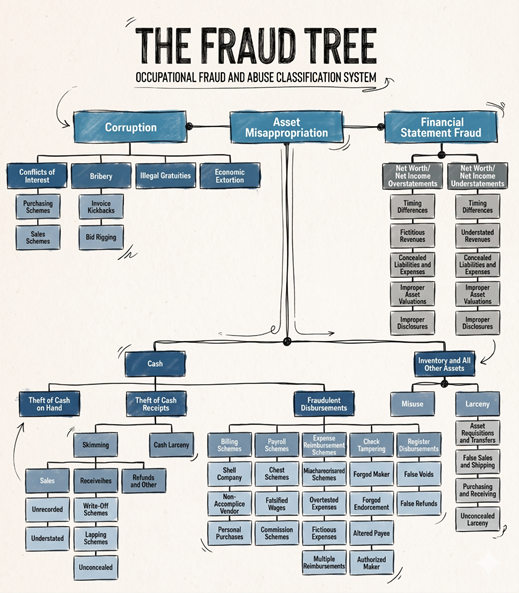
A clear understanding of the Fraud Tree, supported by relevant CFE Material, can help professionals distinguish between different fraud schemes and recognize how each category may affect an organization.
How CFEs use the fraud tree in investigations
Certified fraud examiners (CFEs) use the ACFE Fraud Tree to identify and investigate workplace fraud. They use it in the following ways:
Classified Fraud: Identifying whether suspected fraud involves asset misappropriation, corruption, or financial statement fraud.
Identifying red flags: Examine financial records, employee transactions, and business activities to spot unusual patterns.
Gathering evidence: Review documents and transaction records to understand how the suspected fraud occurred.
Identifying control gaps: Assess weaknesses in internal processes that may allow fraud to take place.
Preventing future fraud: Recommend stronger internal controls and risk management measures to reduce the chances of a similar incident.
How does a Certified Fraud Examiner (CFE) course help?
- A CFE Course can help professionals develop an in-depth knowledge of fraud classification, evidence gathering, and investigative procedures.
- Well-organized CFE Material can also support their preparation by reinforcing key concepts related to fraud detection and prevention.
Identifying the type of fraud is only the beginning; the next step is to establish what happened and how.
How Netrika’s CFE training helps detect and prevent Workplace Fraud
Netrika helps organizations investigate suspected fraud, examine evidence, and identify gaps in their internal processes. The ACFE fraud tree helps businesses understand three main types of workplace fraud: theft of company assets, also called asset misappropriation; being in a higher position and misusing it, known as corruption; and disrupting a company’s financial statements, known as financial statement fraud.
With over 100 years of collective leadership experience, Netrika brings practical knowledge and investigative expertise to fraud-related challenges.
- Why Netrika’s CFE Training Matters: Certified Fraud Examiner training helps employees and professionals recognize suspicious activities and understand how to prevent fraud at work. As an ACFE-authorized training partner in India, Netrika provides structured CFE preparation with authorized trainers and dedicated learning support.
FAQ
- 1. What is the ACFE Fraud Tree?
- The ACFE Fraud Tree is a framework that classifies workplace fraud into three main categories: asset misappropriation, corruption, and financial statement fraud. It helps organizations understand different fraud schemes, identify warning signs, and strengthen fraud prevention measures.
- 2. What are the three main types of occupational fraud?
- The three main types are asset misappropriation (stealing or misusing company assets), corruption (misusing a position for personal gain), and financial statement fraud (deliberately manipulating financial records). Each category includes different schemes that can cause financial and reputational damage.
- 3. Which type of workplace fraud is the most common and the most costly, and how does Netrika’s certified Fraud Examiner training help?
- Asset misappropriation is the most common type of workplace fraud, while financial statement fraud is generally the most costly. Although financial statement fraud occurs less frequently, it can result in significant financial losses for an organization. Netrika’s Certified Fraud Examiner (CFE) training helps professionals understand how workplace fraud occurs, how to identify warning signs, and how to investigate suspicious financial activities.
- 4. How do Certified Fraud Examiners (CFEs) use the Fraud Tree?
- Certified Fraud Examiners use the Fraud Tree to classify suspected fraud, identify red flags, examine financial records, and gather evidence. It also helps them identify weaknesses in internal controls and recommend measures to prevent similar incidents.
- 5. How can organizations prevent workplace fraud?
- Organizations can reduce fraud risks by strengthening internal controls, reviewing financial transactions, conducting regular audits, and training employees to recognize suspicious activities. Certified Fraud Examiner training can also help professionals develop the knowledge and skills needed to identify and prevent workplace fraud.
Can you understand & detect Fraud? Strengthen Your Investigation Skills.
Build Your Fraud Examination Expertise with Netrika’s CFE Training
Learn to identify fraud schemes, recognize red flags, and understand investigative techniques through structured CFE training with an ACFE-authorized training partner in India.
Visit: https://training.netrika.com/ | Call: 1800 121 300000 | Email: info@netrika.com
