

UPI and Digital Payment Fraud in India:Investigation Steps and Forensic AnalysisTraining Needs
UPI and Digital Payment Fraud in India: Investigation Steps and Forensic Analysis Training Needs
To start, how often do you pay in cash nowadays?
All we do is take out our phones, scan, and pay. Whether it’s at the grocery store, booking a cab, or shopping online, it happens. Have you ever stopped for a moment and thought about what happens to the payments behind your back?
A single fraudulent transaction can disrupt your mental health by creating a ruckus inside your head, undermining your savings, and creating stress and exposing the gaps in digital payments. This is where UPI and Digital Payments Investigation comes into the picture. This is where fraud professionals matter.
- Fraud examiner training helps develop the skills required to identify harmful transactions. It also helps understand the fraud patterns, which makes the investigation much easier.
- On the other hand, forensic analysis training also helps simplify how digital footprints can be collected and examined in detail.
- Building a career with CFE training will provide strength in fraud examination, investigation, and prevention.
Digital Payments have made our day-to-day transactions easy. This has also made our lives a lot more convenient. Starting from shopping to transferring money, UPI has become a very vital factor in our lives. We are highly dependent on online and digital footprints. So are the frauds; frauds have taken a step ahead of us. The developing use of digital payment system has also created new opportunity for scammers. It is very easy to manipulate users and get a hold of their money.
Key takeaways:
- The increase and growing use of digital payments have created new opportunities and chances for fraudsters through phishing, QR code scams and fake customer support calls.
- Understanding and investigating how scammers operate is essential to identify suspicious transactions and how it really takes place.
- A UPI fraud investigation includes reviewing complaints, preserving evidence, and examining transactions.
- A major role of understanding the role of forensic analysis training contains evidence collections, preservation and examination can help professionals support fraud investigations.
- CFE certification helps provide in-depth knowledge of how fraud is detected, how fraud is investigated, and how financial analysis and prevention take place, which might strengthen your expertise.
Understanding the growing risks of UPI and digital payment fraud
The convenience of instant transactions comes with a bundle of risks. Scammers have now started to fake call, a mislead email, a fake customer support number to gain the confidential and sensitive information. In many cases, the victims are influenced for the transaction to themselves, which creates importance for the investigation to take place and detect why the fraud is happening,who is doing, and etc. related informations. Only having to use UPI and digital payments will not work in your favour; we should also have full knowledge regarding fraud against UPI and digital payments.
Some common forms of UPI and digital payment fraud include:
Fraudsters often send messages or make calls that are fake. They pretend to represent banks, payment platforms of governmental departments; this is called phishing. There are various QR code scams where the victims are asked to scan a QR code and approve a payment request. Under the false impression that they will receive money.
Some common forms of UPI and digital payment fraud include:
Fraudsters send fake messages or make phone calls. They pretend to represent banks, payment platforms, or government departments, known as phishing. There are many QR scams where victims are asked to scan a QR code or approve a payment request. Under the false impression that they will receive money. Scammers impersonate customer service representatives. They ask users to share confidential information or install remote access applications.
Having a detailed understanding of the methods is a vital part of fraud examiner training. Investigators usually recognize the different ways a fraud can be initiated. CFE training also helps by understanding an in-depth fraud environment, which includes how deception and opportunity can contribute to financial misconduct.
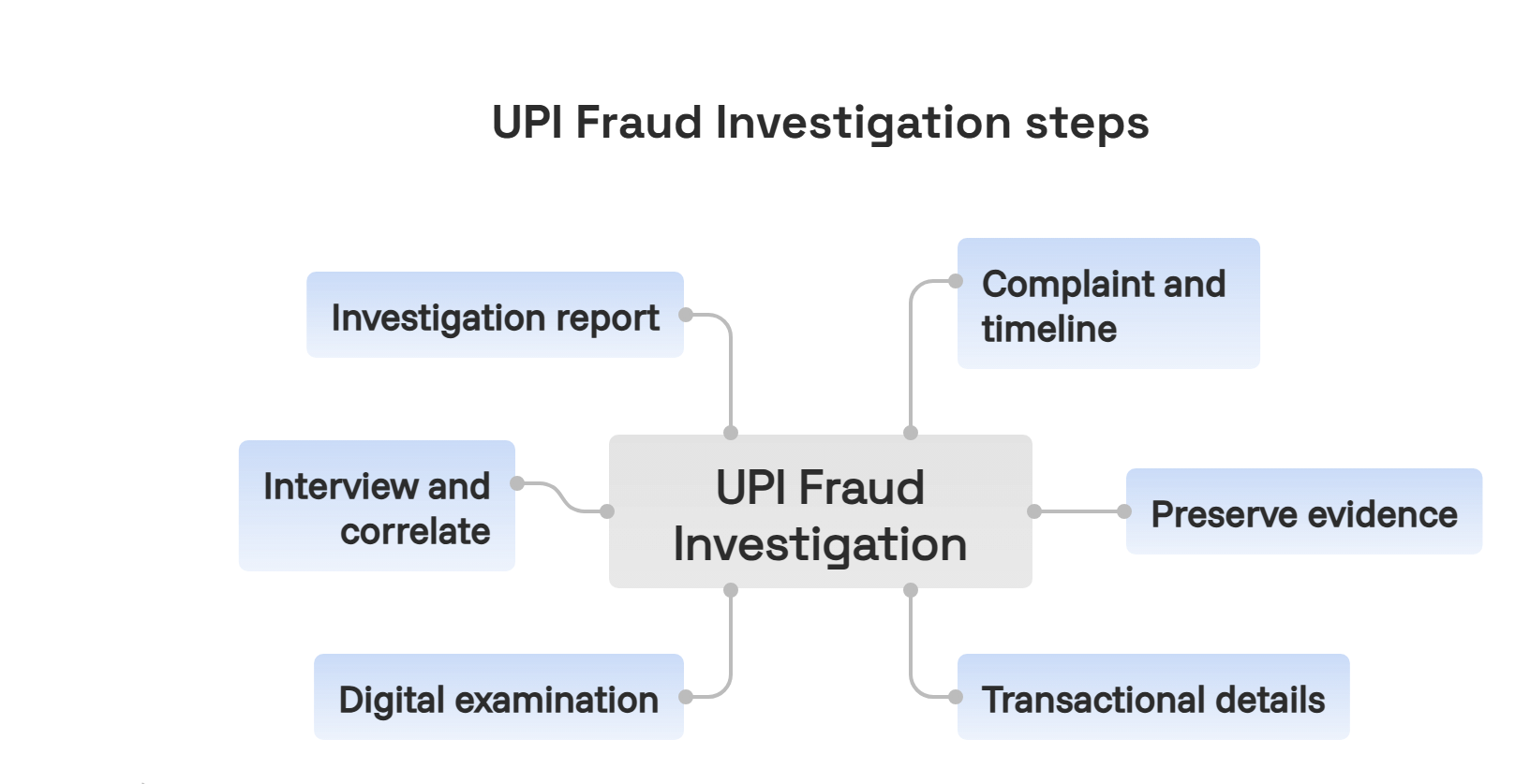
Key steps involved in a UPI Fraud Investigation
The UPI fraud investigation helps us understand what actually happened, how the fraud was carried out, and where the available evidence leads.
The following steps involve:
- Receiving the complaint and establishing the timeline
- Collect and preserving relevant evidence
- Examine transactional details
- Conducting digital evidence examination
- Interviewing relevant individuals and correlating findings
- Prepare the investigation report
Why CFE Certification Commands a Pay Premium
According to the Association of Certified Fraud Examiners (ACFE), its 2024 Global salary survey found that CFEs earned 32% more than non-certified professionals in the survey. CFE training supports career progression by strengthening their understanding of fraud investigation, financial transactions, fraud prevention, and professional ethics. When combined with relevant experience and technical knowledge, CFE training can help candidates demonstrate their readiness for specialized investigation roles.
Organizations need professionals who can do more than identify suspicious transactions. They need individuals who truly can understand fraud schemes, investigative procedures, financial records, internal controls, and prevention strategies.
This is one of the major reasons why a certified Fraud Examiner (CFE) qualification can add value to a professional profile. It demonstrates specialized knowledge of fraud examination and a commitment to professional development.
Explore how fraud schemes work and build the awareness needed to recognize potential warning signs.
CFE Salary in India: Entry-level, mid-career, and senior professionals
A CFE certification helps you explore more career opportunities in fraud examination. But how much can professionals earn in India at different levels of the career stages?
Starting from entry-level to mid-career and followed by senior professionals is a bigger question. The following are the levels and their earnings.
Entry-level professionals earn up to ₹6-9 Lakhs per annum; mid-level professionals can earn approximately from ₹10-15 Lakh per annum finishing up by senior-level professional earn upto ₹15-20 Lakhs per annum. These figures are the typical salary ranges for the CFE-aligned roles. These are the basic salaries for holding a certification.
- Fraud examiner training for a CFE certification at the entry-level helps build a deeper knowledge of concepts such as investigative methods and financial analysis. CFE helps you understand topics related to fraud risk and investigations.
- Working professionals at the mid-level focus on complex investigations, fraud-risk assessments, and team supervision. At the practical level, experience with some specific domain knowledge and forensic analysis training can strengthen a profile.
- At the senior-level professionals keep an eye on investigation teams, which inculcates proframmes under fraud-risk management such as advice management or develop organization-wide fraud prevention strategies. At such stages, certified fraud examiner training helps you develop your leadership responsibilities.
Indicative annual salary range
| Location | Indicative annual salary range |
|---|---|
| Mumbai | ₹6–18 LPA |
| Delhi NCR | ₹6–16 LPA |
| Bengaluru | ₹6–18 LPA |
| Hyderabad | ₹5–15 LPA |
As we all have a knowledge that Mumbai is becoming a key hub in banking and financial services. Meanwhile, Delhi NCR offers more career opportunities in this field related to consulting, corporate investigations, and financial services. Bangalore, on the other hand, is expanding each day; they are developing in the field of technology and the fintech sector, which creates a stronger demand for skilled professionals. Hyderabad then continues to offer roles across IT, financial services, and corporate functions.
Considering the opportunities in these cities has opened up large-scale career opportunities. It’s time for us to now think and look at the bigger picture. Overlooking beyond salaries is the first step. Factors such as job responsibilities, relevant experience, and stronger communication skills, with a drop of investigative expertise in fraud examiner training, can significantly impact career growth and long-term prospects.
How Netrika’s CFE Training Supports Organisations in Addressing UPI Fraud Risks
As we know each passing day, digital payments have started to become our whole life. Surviving without it is very difficult. With ease of life comes an increasing risk factor, such as fraud risks like unauthorized transactions, account takeovers, phishing attacks, social engineering, and payment manipulation schemes. Managing hazardous risk is no cakewalk; it requires professionals who can handle it with caution. Identifying suspicious activities, analyzing transaction patterns and investigating incidents to strengthen fraud control.
Here at Netrika, Certified Fraud Examiner (CFE) training, with the Association of Certified Fraud Examiners (ACFE), helps organizations build capabilities and skills in fraud management, financial investigations, and fraud prevention.
The programme equips professionals with practical knowledge and investigative methodologies that support organisations in managing digital payment and financial crime risks.
- Understanding and learning how financial transactions work, recognising common fraud schemes and identifying suspicious activities that may indicate UPI Fraud.
- There are some specific fraud investigation techniques, such as understanding how to examine transactional records, collect relevant evidence, and follow the financial trail to support in systematic investigations.
- Developing abilities such as financial analysis and evidence examination reviews financial information, identifies irregularities, and understands patterns that may point towards fraudulent transactions.
- Also, adopting skills such as Fraud prevention and deterrence can help you identify vulnerabilities, strengthen internal controls, and reduce the risk of financial fraud.
Why Netrika’s CFE Training
- Netrika is ACFE-authorised training partner delivering structured preparation aligned with globally recognised fraud examination standards.
- Experienced trainers with expertise in fraud risk management, corporate investigations, forensic reviews, and compliance.
- Instructor-led sessions that combine conceptual learning with practical discussion and case-based insights.
- Comprehensive study resources, including practice assessments, examination preparation materials, and access to the Fraud Examiners Manual.
- Structured curriculum covering fraud schemes, investigations, legal considerations, and fraud prevention methodologies.
With the right knowledge and practical understanding, professionals can become better equipped to recognise fraud indicators, examine suspicious financial activities, and support effective investigations. Netrika’s CFE training helps build this foundation for professionals looking to develop their careers in fraud examination, financial investigations, and fraud risk management.
FAQs
- 1. How useful is CFE for a career in UPI fraud investigation?
- Yes, CFE certification develops knowledge of fraud schemes, investigation methods, financial transactions, and prevention.
- 2. Does CFE training teach digital forensics?
- CFE training covers examination and investigation principles. It can introduce learners to evidence-related concepts, but specialist mobile forensics, malware analysis, and advanced device examination require additional training.
- 3. Who should consider fraud examiner training?
- Banking professionals, auditors, compliance officers, risk management specialists, investigators and finance professionals who want to develop expertise in fraud detection and investigation can consider this learning path.
- 4. How can forensic analysis training support fraud investigators?
- It helps professionals understand digital evidence preservation, documentation and examination principles. The knowledge can support investigations involving suspicious applications, communication records, and electronic transactions.
Can your team identify and investigate digital payment fraud before it escalates?
Strengthen your fraud investigation skills with Netrika’s CFE training
Build the knowledge and investigative capabilities needed to understand fraud patterns, fraud detection, and support effective fraud investigation with Netrika’s CFE training.
Visit: https://training.netrika.com/ | Call: 1800 121 300000 | Email: info@netrika.com
