

Beyond Financial Loss: How Fraud Threatens Business Stability
Beyond Financial Loss: How Fraud Threatens Business Stability
Fraud is not just about losing money; it can affect how an entire business functions. From damaging its reputation and weakening stakeholder trust to disrupting daily operations and creating regulatory challenges, its impact can be far-reaching. A single incident can disrupt a large number of workflows, create uncertainty among employees, and make clients question whether the business is reliable. While financial losses are often the first concern, the impact can extend to employee trust, customer relationships, business reputations, and daily operations.
This is why understanding fraud goes beyond identifying financial damage. Businesses also need to recognize its wider impact on people, operations, and long-term stability to protect what they have built. For aspiring Certified Fraud Examiners (CFEs), understanding these consequences is important to recognising how fraud affects business stability and why early detection, effective investigations, and preventive measures matter.
Protecting a business from fraud starts with understanding the risks that extend beyond financial loss.
Key Takeaways:
- Fraud damages business reputation: A single incident can weaken customer trust, affect brand credibility, and strain business relationships.
- Employee morale takes a hit: Fraud can create suspicion, blame, and uncertainty, affecting workplace culture and productivity. Certified Fraud Examiners help establish facts through structured investigations rather than assumptions.
- Operational disruptions increase costs: Investigations, stricter approval processes, and recovery efforts can interrupt daily business activities. FEs help trace suspicious transactions and identify control gaps to reduce further disruption.
- Financial losses go beyond stolen funds: Legal expenses, regulatory penalties, customer loss, and reputational damage can add to the overall cost of fraud.
- Strong internal controls reduce fraud risks: Regular audits, employee training, clear policies, and continuous monitoring help identify vulnerabilities and suspicious activity. CFE expertise can help organizations recognize weaknesses and improve fraud prevention measures.
- Fraud resilience requires expert support: Timely investigations, evidence collection, root-cause analysis, and preventive measures help businesses respond to incidents and strengthen their defenses against future fraud.
How Fraud Damages Business Reputation
Fraud doesn’t just cost business money; it can damage the trust and reputation it takes years to build.
Fraud damages a business reputation by destroying public trust, driving away customers, and degrading relationships with vendors, investors, and regulators.
Key ways fraud damages reputation:
Loss of customer trust and loyalty:
When customers experience and learn about fraud such as data breaches and billing scams, they lose confidence in the brands and take their business elsewhere, increasing customer churn and acquisition costs. Certified Fraud Examiners help organizations investigate fraudulent transactions, establish how the incident occurred, and identify weaknesses in the processes involved. Addressing these issues helps businesses make informed decisions about corrective measures and rebuilding customer confidence.
Social media/Public image decay:
Nowadays, a lot of information is passed through social media platforms. A large amount of information is disinformation. Negative sentiments spread rapidly online, turning localized fraud or security failure into a widespread public relations crisis that could impact the brand image. A CFE can help establish the facts by examining transaction records, reviewing available evidence, and identifying the nature and extent of suspected fraud.
Identity Hijacking and False Association:
Criminals impersonate a business to commit fraud; the legitimate company often absorbs the immediate public backlash and hostile client enquiries before the disclosure of the breach. Certified Fraud Examiners-led investigations can help trace suspicious transactions, examine supporting records, and establish the facts surrounding suspected fraudulent activity.
Rebuilding trust takes time. Identifying fraud risks early can help businesses protect the reputation they have worked hard to build.
Fraud’s Impact on Employee Trust and Morale
In the UK, the Economic Crime Survey 2024 found that 27% of UK businesses with employees experienced fraud during the previous 12 months, equating to around 389,000 businesses.
Fraud within an organization not only results in financial loss but also significantly damages the workplace environment and disrupts the psychological well-being of the workforce. The impact on employee morale is generally negative; when fraud occurs, especially if committed by management or peers, it destroys the foundation of trust. Employees feel betrayed and backstabbed when an incident like this occurs.
How fraud affects the workplace:
1. Creates a culture of blame
When fraud is discovered, departments may become defensive, and employees may worry about being unfairly blamed. Trust between teams can weaken, affecting collaboration and productivity.
CFE expertise helps organizations examine the available evidence, establish how the incident occurred, and distinguish verified facts from assumptions. This supports a more objective investigation and helps management determine appropriate next steps.
2. Raises questions about internal controls
Employees may question why suspicious transactions went unnoticed, why a vendor was not properly verified, or why warning signs were missed.
CFEs investigate the circumstances surrounding suspected fraud to identify control failures and weaknesses in existing processes. Their findings can help organizations understand whether the incident resulted from deliberate misconduct, inadequate oversight, or gaps in established procedures.
3. Increases workplace pressure
Following a fraud incident, organizations may introduce additional approvals, documentation requirements, verification steps, and monitoring procedures. Although these measures can be necessary, poorly designed processes may increase workloads and frustrate employees.
By identifying the specific weaknesses that allowed fraud to occur, CFE-led investigations can help businesses make more targeted improvements rather than relying solely on excessive checks and approvals.
4. Weakens confidence in management
Employees expect management to protect organizational resources and maintain a fair working environment. When fraud exposes gaps in oversight, confidence in leadership can decline.
A structured fraud investigation helps management understand what went wrong, who was involved, and which safeguards need improvement. Taking action based on evidence demonstrates accountability and helps rebuild confidence across the organization.
Employee trust is difficult to rebuild when the reasons behind fraud remain unclear. CFE expertise helps businesses establish the facts, address weaknesses, and create a stronger foundation for accountability.
How Fraud Disrupts Business Operations
A recent survey conducted by the Association of Certified Fraud Examiners (ACFE) analyzed data from over 2,000 real-world fraud cases spanning 133 countries and 23 industries. According to this report, occupational fraud causes annual losses of more than $4.7 trillion globally, and organizations lose about 5% of their revenue to fraud each year. In a worrying trend, several organizations cite that regulatory changes have not been very effective in tackling fraud, leaving organizations to their own devices in the fight.
Businesses that don’t actively take appropriate action towards fraud prevention are exposing themselves to potentially disastrous aftermath. For a better understanding of the true cost to victims of fraud, it is necessary for us to first consider how it affects the health of businesses in the long term, both financially and otherwise.
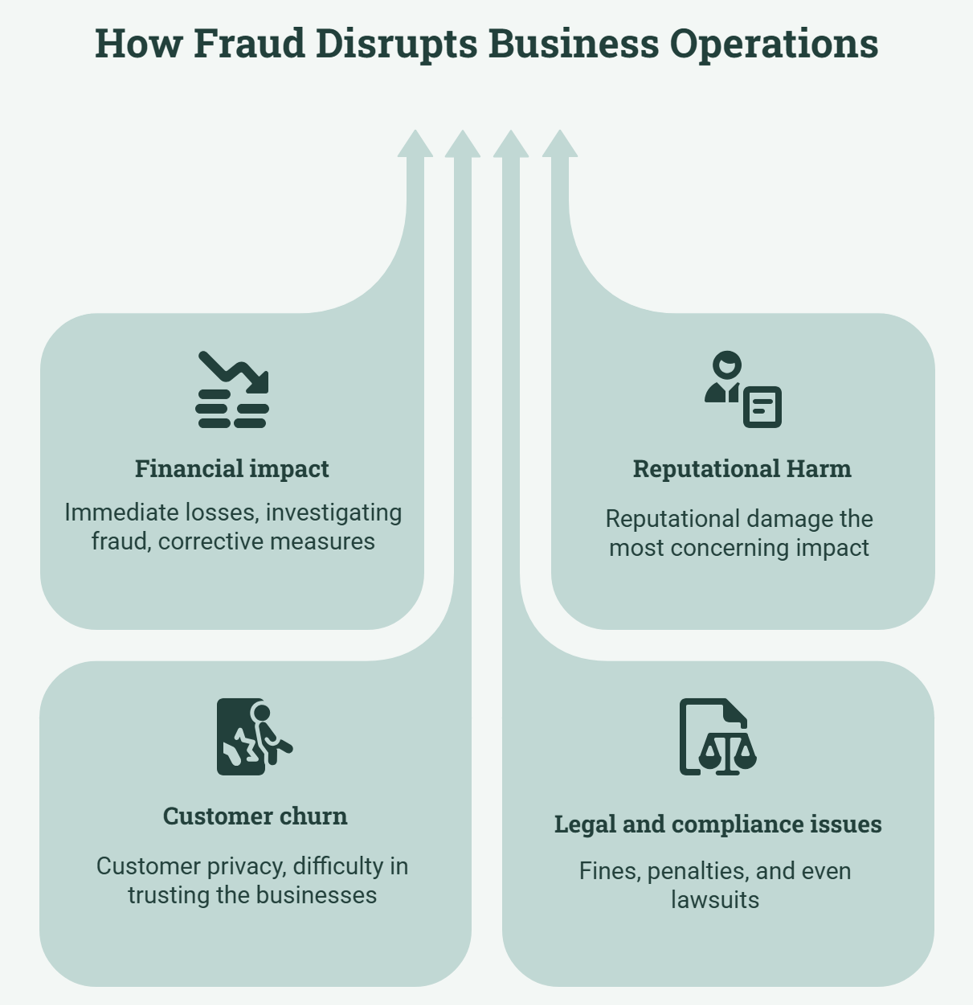
Fraud not only impacts businesses financially, but it also harms reputation, customer churn, legal and compliance issues, workforce morale and efficiency, etc. CFEs help organizations understand the operational impact of suspected fraud by tracing transactions, examining records, gathering evidence, and identifying the processes that were exploited.
Financial impact:
The financial impact of fraud extends beyond the immediate losses incurred. An organization often must direct funds towards investigating fraud, implementing corrective measures, and dealing with potential legal consequences. Businesses can experience downtime that not only affects the bottom line but also affects employee morale and customer relationships, leading to further financial losses.CFEs can help businesses trace suspicious transactions, assess the available financial evidence, and establish how the loss occurred.
Reputational Harm:
When fraud occurs, the very direct impact automatically harms the reputation of an organization. According to a leading consulting firm’s survey in India, as much as 72% of the organizations surveyed consider reputational damage the most concerning impact of fraud. Certified Fraud Examiners help establish the facts surrounding an incident and identify the weaknesses that contributed to it.
Customer churn:
During the increasing reliance on digital tools and data, has been jeopardized the customer privacy to an unprecedented level; leaving the customers hyper-alert and difficulty in trusting the businesses during the incident. This results in significant negativity in the customer experience. FE investigations can help organizations understand how the fraud occurred, identify affected processes, and recommend improvements to relevant controls.
Legal and compliance issues:
Legal and regulatory non-compliance issues from a fraud incident can invite a load of fines, penalties, and even lawsuits. The vicious cycle of the reputational damage is directly related to the legal ethics which cracks in the system. CFEs help investigate suspected misconduct, organize relevant evidence, and document findings that can support internal decision-making and further legal review.
Understanding the wider impact of fraud helps businesses prepare for disruptions, limit further losses, and protect operational continuity.
Preventing Fraud Through Strong Internal Controls
According to an ACFE survey in 2016, participants estimated that the typical organization loses 5% of its revenues to fraud each year, and more than three-fourths of frauds were committed by individuals working in seven key departments: accounting, operations, sales, executive/upper management, customer service, purchasing, and finance.
Preventing organizational fraud relies heavily on manipulating the fraud triangle. Many organizations assume fraud happens because of the bad actors alone. Fraud often occurs when weaknesses in internal controls create opportunities for misconduct to go undetected. Below are seven foundational internal controls every organization should implement to reduce fraud risk and strengthen financial oversight.
Use of fraud detection and prevention software:
- Organizations should incorporate advanced fraud detection and prevention techniques using modern fraud technology to identify and prevent suspicious activity. Such software typically integrates with multiple data sources to track customer behavior and transaction activity, including automated transaction monitoring and machine learning-based analytics.
Deployment of risk management systems:
- Organizations should implement a comprehensive risk management system to quickly prevent and respond to fraud and comply with regulatory obligations.
- This system should include a centralized risk engine that automates the evaluation of customer activity and transaction monitoring. The risk engine should also enable corporations to customize risk assessment tasks.
Training of employees:
- Employees should be provided with sufficient training to ensure they understand the organization’s fraud policies and procedures.
- They should also receive regular risk and fraud awareness training, as well as be regularly tested to ensure they are up to date with new risk management trends.
Education of customers:
- Organizations should provide customers with necessary information about fraud and the measures they can take to protect themselves.
- Customers must be aware of the risks associated with online transactions and understand the secure methods to comply with regulations.
Regular evaluation of the fraud compliance program:
- Organizations should assess the effectiveness of their fraud compliance program regularly. This can involve reviews of internal processes, monitoring of customer accounts, and testing of tools and software.
- Identifying any gaps in the program or suspicious behaviors can help organizations stay ahead of fraudsters and maintain an effective fraud prevention program.
Fraud prevention is not achieved through a single policy or annual review. It requires a combination of people, processes, oversight, and accountability working together to create a strong system of internal controls. According to top annual ACFE research, anonymous tips are consistently the #1 way fraud is exposed, outperforming traditional audits by a massive margin.
Strong control environments divide responsibilities among multiple individuals whenever possible. Organizations often rely heavily on a few key individuals for accounting, payroll, or financial reporting processes. From an audit perspective, organizations that cross-train employees generally have more resilient control environments because multiple individuals understand and can review critical financial activities.
Building Business Resilience Against Fraud
According to ACFE benchmarks, organizations typically lose an estimated 5% of annual revenue to fraud, and programs with active anti-fraud controls detect and mitigate incidents significantly faster. Business resilience is not about being completely immune to fraud; it is about reducing the opportunity for fraud, detecting it rapidly when it occurs, and having the structural strength to recover with minimal disruption. The Certified Fraud Examiners ensures that your fraud defense is designed by a specialist who understands the psychological, financial, and legal mechanics of financial crime. The core pillars of business resilience against fraud:
- Culture & tone at the top
- Robust internal controls
- Continuous monitoring and data analytics
- Incident response readiness
The Association of Certified Fraud Examiners (ACFE) trains CFEs across four distinct pillars.
CFE’s role:
A CFE plays a critical role in business resilience during a fraud incident by rapidly containing financial damage, uncovering the root cause, preserving legally admissible evidence, and guiding the strategic recovery. CFE steps in immediately to isolate compromised accounts, freeze unauthorized disbursements, and halt active internal or external asset misappropriation. Certified Fraud Examiners analyze complex transactions and digital footprints to map out how the breach or fraud occurred.
How Netrika CFE helps businesses prevent fraud
Netrika combines investigative expertise with fraud risk assessment to help organizations identify vulnerabilities, investigate suspected misconduct, trace suspicious transactions, and gather evidence to support informed decisions. Netrika’s Certified Fraud Examiner (CFE) training expertise further strengthens its focus on fraud awareness and prevention. With over 100 years of collective leadership experience and a presence across India, UAE, Singapore, and Sri Lanka. Netrika supports businesses in strengthening internal controls, reducing fraud risks, and building long-term resilience.
Through our expertise in Certified Fraud Examiners and structured fraud investigation and prevention training, professionals learn to understand fraud schemes, assess vulnerabilities, and recommend measures to reduce the likelihood of future incidents. This expertise helps organizations strengthen accountability, protect financial resources, and make informed decisions. Netrika’s Certified Fraud Examiner (CFE) programme equips professionals with the knowledge and skills to recognize fraud risks, examine financial records, gather evidence, and identify weaknesses in internal controls.
This expertise helps organizations strengthen:
- Accountability
- protect financial resources
- make informed decisions
when fraud is suspected. By building:
- in-house fraud examination capabilities
- businesses can improve their preparedness
- minimize disruptions
- strengthen long-term stability
When Fraud Occurs, the Right Response Matters.
Strengthening Fraud Prevention with Netrika
Netrika CFE helps businesses investigate suspected fraud, examine evidence, identify control gaps, and take informed steps towards recovery and prevention.
Visit: https://training.netrika.com/ | Call: 1800 121 300000 | Email: info@netrika.com
