
CIA Part 1 Exam Guide 2026: Syllabus, Topics, and Essentials of Internal Auditing
CIA Part 1 Exam Guide 2026: Syllabus, Topics, and Essentials of Internal Auditing
Did you know?
CIA Part 1 exam is aligned with the IIA’s Global Internal Audit Standards, which became effective on January 9, 2025, shaping modern internal audit practices.
Starting your CIA journey becomes easier when you know what to expect from the first part of the exam. CIA Part 1 of Internal auditing introduces candidates to the fundamental concepts and practices that form the foundation of internal auditing. This CIA exam Part 1 essentials of internal auditing complete guide gives candidates an overview of the key areas they need to understand before appearing for the examination. This CIA exam also helps candidates understand the CIA exam Part 1 syllabus and the essentials of internal auditing before beginning their preparation.
Here’s what you need to know:
- The format of the CIA Part 1 exam includes 125 multiple-choice questions.
- Candidates need to complete the exam within 150 minutes.
What Is the CIA Exam Part 1: Essentials of Internal Auditing Complete Guide
Understanding the exam format is an important part of preparing for CIA Part 1. Candidates should also review the CIA Part 1 structure and requirements before starting their preparation.
What does CIA exam Part 1 cover?
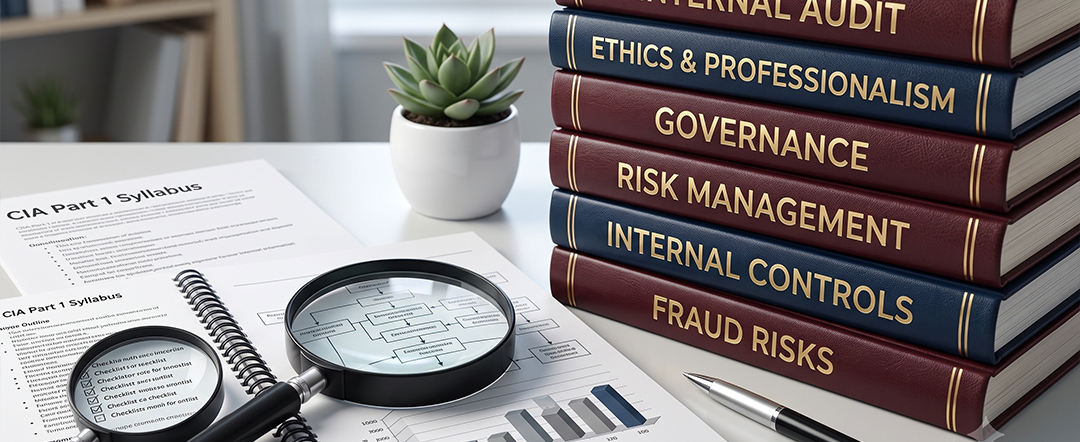
The CIA exam Part 1 syllabus introduces key areas such as the purpose and mandate:
- Internal audit
- Ethics and professionalism
- Governance
- Risk management
- Internal controls
- Fraud risks
These topics help candidates understand how internal audit supports organizations in managing risks and strengthening controls. The CIA exam Part 1 syllabus provides the foundation candidates need to understand the essentials of internal auditing.
Key Takeaways:
- Before you start preparing, take some time to become familiar with the CIA Part 1 exam pattern. Know how many questions the CIA Part 1 exam contains, what the time limit for the exam is, and what the syllabus for the CIA Part 1 exam includes.
- Focus on building a grasp of the four areas: Foundations of Internal Auditing, Ethics and Professionalism, Governance, Risk Management and Control, and Fraud Risks.
- Think about how internal auditing helps organizations. Internal auditing supports governance, improves risk management, strengthens controls, and helps leaders make smarter decisions. When you see how internal auditing fits into the picture, the topics start to make sense.
- Topics like fraud, risk, controls, and governance can feel abstract if you only read about them in books. When you connect them to actual workplace situations like a weak approval process or a suspicious expense claim, they become much easier to understand. Try to picture how they work in life.
- Finally, don’t forget the side of the exam day. Go through the exam rules ahead of time. Know what ID you need to bring. Learn the testing-centre procedures. Check the calculator policy. Understand what’s expected in terms of confidentiality. Being prepared for these details helps you stay calm and focused on exam day.
Keep these preparation points in mind as you build your CIA Part 1 study plan.
Why CIA Part 1 Matters for Internal Auditing and Organizations in India
For organizations in India, internal auditing is no longer about checking records. I see that businesses face regulations, digital risks, fraud worries, and higher governance demands. Internal auditing must help organizations stay ready and strong. Internal auditors are now keeping organizations prepared and resilient. CIA Part 1 helps professionals learn the basics to contribute effectively to this environment. The CIA Part 1 preparation process can also help candidates connect the CIA exam Part 1 syllabus with practical internal audit responsibilities.
- Helps navigate expectations: Organizations, especially those in regulated sectors, need strong governance, internal controls, and risk-management practices. CIA Part 1 helps candidates understand how internal audit supports these areas.
- Builds awareness of fraud and risk: As businesses adopt technologies and processes, the nature of fraud and operational risks also changes. Part 1 introduces professionals to fraud risks, controls, and risk-management concepts that are relevant to these challenges.
- Clarifies the Three Lines Model: The syllabus introduces the IIA’s Three Lines Model, helping professionals understand how management, risk and compliance functions, and internal audit work together while maintaining responsibilities.
- Strengthens internal audit practices: More importantly, CIA Part 1 builds a practical foundation for understanding governance, risk, controls, ethics, and internal audit responsibilities, knowledge that can support stronger and more effective internal audit functions across Indian organizations.
See how concepts covered in CIA Part 1 connect with the realities of modern internal auditing.
Core Components and Areas Covered in CIA Part 1
CIA Part 1 Internal Audit Fundamentals helps you learn what internal auditing means and how it helps a company. These topics matter for the exam. They also show the ideas that internal auditors use every day. Understanding these areas is central to the CIA exam Part 1 syllabus and the essentials of internal auditing.
- Foundations of Internal Auditing (35 %): This section covers the mission, purpose, and mandate of auditing, the International Professional Practices Framework (IPPF), the difference between assurance and advisory services, and the concepts of independence and objectivity.
- Ethics and Professionalism (20 %): This part talks about the principles and professional behavior that internal auditors must follow, such as integrity, objectivity, confidentiality, and professional competence.
- Governance, Risk Management and Control (30 %): This area looks at governance structures, enterprise risk management (ERM) frameworks like COSO, risk types, and the design of internal controls, including preventive, detective, and corrective measures.
- Fraud Risks (15 %): This section explores fraud risk ideas, the fraud triangle, warning signs, and common schemes such as cyber and digital fraud. It shows how internal auditors evaluate and plan for fraud during an audit.
Together, these areas give candidates a view of the fundamentals of auditing. They also build the knowledge base that candidates need to understand ideas as they progress with the CIA certification. The essentials of auditing are therefore a foundation for candidates preparing for the exam.
Netrika’s Approach to CIA Part 1 Exam Preparation
Preparing for CIA Part 1 can feel overwhelming. There is material to cover, and if candidates are also handling work or other professional duties, finding the best study method can be difficult. The key is not to finish the syllabus but to understand internal audit concepts, identify where to focus effort, and feel at ease applying knowledge.
At Netrika, the preparation approach centers on this understanding. The focus is on helping candidates prepare for CIA Part 1 while also developing a grasp of internal audit. This approach keeps the CIA Part 1 preparation focused on the essentials of internal auditing.
- Start with fundamentals: Candidates are guided through Part 1 areas such as internal audit foundations, independence and objectivity, governance, risk management, internal controls, and fraud risks. The focus is on understanding audit concepts rather than simply memorizing them.
- Concepts to real situations: Internal audit becomes easier to understand when candidates can relate internal audit concepts to situations that occur within organizations. Practical examples help candidates see how internal audit concepts work beyond the textbook.
- Practice and track progress: Practice questions and mock assessments help candidates understand where they stand, identify areas that need attention, and become more comfortable with the CIA Part 1 exam format.
- Learn with expert guidance: Structured sessions and trainer support give candidates direction for preparation and help candidates work through internal audit concepts that may be difficult.
For Netrika, CIA preparation is about more than passing an examination. It is about helping candidates build an understanding of internal audits, risk, and controls that candidates can continue to use as they grow in their professional careers.
Explore a structured approach to understand the concepts, practice questions, and prepare for CIA Part 1.
Step-by-Step Guide to Preparing for the CIA Part 1 Exam
Preparing for CIA Part 1 becomes much easier when you have a clear plan instead of trying to cover everything at once. Here’s a step-by-step approach to help you stay organized and prepare with confidence. Reviewing the CIA exam Part 1 syllabus before following these steps can help candidates plan their preparation more effectively.
- Step 1: Understand the Exam First
- Step 2: Break Down the Syllabus
- Step 3: Focus on Understanding Concepts
- Step 4: Create a Realistic Study Plan
- Step 5: Practice Regularly
- Step 6: Learn from Your Mistakes
- Step 7: Take Timed Mock Tests
- Step 8: Revise and Prepare for Exam Day
Practical Applications for Internal Auditing
Internal auditing helps organizations understand their risks, identify gaps, and strengthen the way they operate. For CIA Part 1 candidates, seeing these concepts through examples can make the subject far easier to understand. I find that real examples are very helpful. These practical applications also bring the essentials of internal auditing to life for CIA Part 1 candidates.
- An internal auditor may check if transactions are properly authorized, recorded accurately, and backed up by documentation.
- If a company often faces delays in procurement or service delivery, an internal auditor may review the process to spot the gaps and the risks that arise.
- Internal auditors may review user access, data protection, and system controls to decide if sensitive business information is adequately protected.
- Internal auditors can assess fraud risks, review existing controls, and spot activities or weaknesses that could be exploited.
- Internal auditors may evaluate whether business processes align with laws, regulations, internal policies, and organizational standards.
- Internal auditing can give management and those charged with governance insights into whether key processes, controls, and risk management practices are working effectively.
CIA Part 1 in India: Regulatory, Professional and Compliance Considerations
Preparing for CIA Part 1 is not about studying the syllabus. Candidates must also know the exam rules and procedures so that they know what to expect on exam day. Understanding the CIA exam Part 1 syllabus is only one part of preparing for the examination.
- Know the exam format: CIA Part 1 has 125 questions. Candidates have 150 minutes to finish the exam. Knowing this helps you plan your time.
- Carry an ID: Bring an acceptable, valid government-issued ID when you go to the exam.
- Maintain exam confidentiality: CIA is an exam. Candidates must not copy, record, discuss, or share any exam questions or answers.
- Follow testing centre instructions: Follow the security and check-in rules at the Pearson VUE centre.
- Understand the break policy: There are no scheduled breaks. If you take a break, the clock keeps running.
- Follow calculator rules: Personal calculators are not allowed. Use the calculator. A handheld calculator may be given at the centre if available.
- Accept the confidentiality agreement: Agree to the exam confidentiality rules before starting the test.
Following these rules helps you avoid problems on exam day. Before you sit for CIA Part 1, check the guidelines from the IIA because exam rules can change.
Why Choose Netrika for CIA Part 1 Exam Preparation?
A CIA Part 1 exam candidate says, “Preparing for CIA Part 1 with Netrika strengthened my understanding of internal auditing and improved my confidence in applying concepts. The guidance and practical learning helped me pass successfully.”
Preparing for CIA Part 1 is not about going through the syllabus. It takes more than that. Candidates need to understand the concepts, practice consistently, and fit their study routine into busy work or academic lives. A clear and organized approach makes all the difference. It brings focus and direction to the journey. For candidates following the CIA Exam Part 1 Essentials of Internal Auditing complete guide, this approach can help connect exam preparation with practical learning.
At Netrika, we believe in building a foundation first. We help candidates grasp the core ideas and steadily grow their confidence through guided learning and regular practice.
- 100+ hours of live training: Candidates get hands-on sessions, with trainers who explain important CIA topics, answer questions, and support real-time learning.
- 18 months of GLEIM access: This gives candidates time to revise, practice, and study at their own speed without pressure.
- Practice and simulated exams: Regular question practice and full-length mock tests help candidates get used to the real exam setting and improve how they use their time.
- First-attempt success rate: Netrika proudly shares stories of candidates who passed CIA Part 1 on their first attempt. This shows the results that come from following our program.
- Highly experienced trainers: Learners are taught by professionals who have worked in audit, finance, risk, and compliance. They bring real-world knowledge into every session.
The idea is simple: instead of studying the syllabus in isolation, candidates get a structured learning journey that combines concept clarity, practice, and exam preparation.
Explore a more structured way to approach your CIA Part 1 preparation with Netrika’s Training team.
FAQ
- 1. What does the CIA Part 1 exam cover?
- CIA Part 1 covers internal audit foundations, ethics, governance, risk management, internal controls, and fraud risks.
- 2. What is the duration of the CIA Part 1 exam?
- Candidates have 150 minutes to complete the CIA Part 1 exam, which consists of 125 multiple-choice questions.
- 3. What are the main areas in the CIA Part 1 syllabus?
- The main areas include Foundations, Ethics and Professionalism, Governance, Risk Management and Control, and Fraud Risks.
- 4. What is the best way to prepare for CIA Part 1?
- Build conceptual clarity, follow a realistic study plan, practice questions regularly, and revise key topics before the exam.
- 5. Can working professionals prepare for CIA Part 1?
- Yes, working professionals can prepare by creating a manageable study schedule and consistently balancing preparation with their professional commitments.
Preparing for CIA Part 1? Start with the Fundamentals.
Build your understanding of internal audit concepts, risk, controls, governance, and fraud risks with a structured approach to CIA Part 1 preparation.
Netrika’s Training team focuses on building concept clarity that candidates can carry beyond the examinations.
Visit: www.netrika.com | Call: 1800 121 300000 | Email: trust@netrika.com
